
The Legacy of the Enlightenment: Progress or Eurocentric Myth?
TRADITIONS & CULTURAL CHAOS
3/10/20264 min read

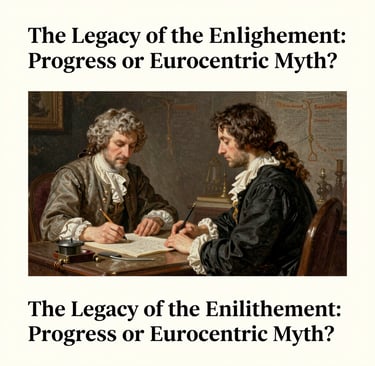
Understanding the Enlightenment: A Historical Overview
The Enlightenment, a pivotal intellectual movement that emerged in Europe during the late 17th and 18th centuries, was marked by an unprecedented embrace of reason, science, and individual rights. It sought to challenge traditional authority and advance human knowledge beyond the constraints of religious dogma. The seeds of the Enlightenment were sown in earlier philosophical inquiries but flourished in a context that emphasized rational inquiry and empirical evidence. Key figures of this era, including Voltaire, Jean-Jacques Rousseau, and Immanuel Kant, played instrumental roles in shaping its core principles.
Voltaire, a prolific writer and philosopher, advocated for civil liberties, including freedom of religion and expression. His satirical works criticized the status quo and highlighted the abuses of power, promoting the idea that progress was achievable through critical thought. Rousseau introduced concepts of the social contract and the inherent goodness of humanity, arguing that society often corrupted natural human virtues. His contributions to political philosophy emphasized the importance of individual agency and collective governance.
Kant's philosophy further deepened Enlightenment thought, specifically through his work on morality and autonomy. He asserted that reason is the foundation of ethical deliberation, which underscored the belief in individualism that became synonymous with the Enlightenment. These intellectual advancements fostered a climate of skepticism towards tradition, encouraging individuals to question established norms and seek reforms.
While the Enlightenment heralded progress through the promotion of rationality and human rights, it also had complex implications. Its legacy is often debated; some argue it laid the groundwork for modern democracy and scientific achievement, while others highlight how it perpetuated social hierarchies and Eurocentric narratives. Understanding the Enlightenment requires a nuanced appreciation of its dual nature, encapsulating both its revolutionary ideals and its limitations.
The Positive Legacy: Democracy, Science, and Human Rights
The Enlightenment period, spanning the late 17th to the 18th century, is often hailed as a transformative era that laid the foundation for modern democratic ideals, scientific inquiry, and the recognition of fundamental human rights. Enlightenment philosophers such as John Locke, Voltaire, and Jean-Jacques Rousseau emphasized the importance of individual liberty and equality, which directly influenced the development of democratic systems. Their theories argued for the consent of the governed and the right to resist tyranny, establishing principles that would later underpin constitutions and democratic frameworks worldwide.
Advancements in science were also integral to the Enlightenment legacy. The scientific revolution encouraged a departure from superstition and dogma, advocating for empirical evidence and rational thought. Figures like Isaac Newton and Francis Bacon promoted the scientific method, which emphasized observation, experimentation, and critique as the basis of knowledge. This shift not only advanced various scientific disciplines but also fostered a broader culture of inquiry and skepticism, encouraging individuals to challenge established norms and beliefs.
Moreover, the Enlightenment's impact on human rights cannot be overstated. Thinkers of this period laid the groundwork for the recognition of natural rights, arguing that all individuals possess inalienable rights that derive from their humanity. This notion directly influenced subsequent human rights documents, such as the Declaration of Independence and the Universal Declaration of Human Rights, thereby promoting dignity and equality that resonate in contemporary legal frameworks.
In essence, the Enlightenment's contributions to democracy, scientific progress, and the recognition of human rights are pivotal to understanding modern society. These concepts fostered societal shifts that continue to shape political and social landscapes today, elevating the importance of individual rights and scientific understanding as cornerstones of contemporary existence.
The Dark Side: Colonialism, Racism, and Patriarchal Structures
The Enlightenment era is often celebrated for its advancements in reason, science, and individual rights; however, its legacy is complicated by the exclusionary practices that accompanied its philosophical discourse. The ideals of the Enlightenment were primarily reserved for a select group, typically white European males, which facilitated the marginalization and oppression of others. This exclusion resulted in significant opposition, particularly from the perspectives of colonialism, racism, and patriarchal structures, which were not incidental to Enlightenment thought but rather deeply intertwined.
Enlightenment philosophers, while advocating for liberty and equality, frequently justified colonialism as a civilizing mission. Figures such as John Locke and Immanuel Kant promoted ideas that implicitly deemed non-European societies as inferior. This perspective not only rationalized the exploitation and domination of colonized regions but also fostered a mindset that regarded colonizers as benevolent figures bringing progress. The consequent disenfranchisement of indigenous cultures set the stage for systemic racism, as these societies were deemed incapable of self-governance, further entrenching Eurocentric views of cultural superiority.
Moreover, the Enlightenment's emphasis on rationality reinforced patriarchal structures, casting women and non-Western individuals as irrational or incapable of contributing to the public sphere. Philosophers like Rousseau and Hobbes embedded gender hierarchies within their frameworks, arguing for a natural order that placed men in positions of power while subjugating women. This ideological foundation facilitated the continuation of patriarchal dominance, shaping gender roles and expectations that persisted long after the Enlightenment period. Thus, the promotion of equality and rational thought was paradoxically used to sustain oppressive systems, calling into question the overall impact of this era on global societies.
Contemporary Perspectives: Debates on the Enlightenment's Legacy
The Enlightenment period, often celebrated for its emphasis on reason, individualism, and progress, has become a focal point of contemporary scholarly debates regarding its legacy. Diverse interpretations of Enlightenment values have sparked debates about whether these ideals truly liberated societies or, conversely, fostered new forms of domination. Among the modern interpretations, some scholars argue that the Enlightenment's promotion of rational thought and empirical inquiry significantly advanced social and political progress, contributing to the development of democratic institutions and human rights. However, this view is increasingly challenged by critiques that highlight the darker side of Enlightenment thought.
Critics assert that while the Enlightenment aimed to liberate humanity from ignorance, it inadvertently laid the groundwork for colonialism and imperialism. Enlightenment figures, steeped in Eurocentrism, often held views that dismissed non-European cultures as inferior. This perspective, they argue, has paved the way for contemporary globalization, which often replicates historical power imbalances between the Global North and South. As a result, the legacy of the Enlightenment is viewed by some as a double-edged sword, where the progress it purported to bring about is entangled with the perpetuation of social inequalities.
In the current climate, the principles derived from Enlightenment thought are being reevaluated in the context of multiculturalism and social justice. Advocates for social equity argue that the Enlightenment's emphasis on reason should be reinterpreted to include the voices and experiences of marginalized communities. This reevaluation seeks to create a more inclusive understanding of progress, challenging the primarily Eurocentric narrative of Enlightenment history. Consequently, these contemporary debates reflect an ongoing struggle to reconcile the Enlightenment's lofty ideals with the realities of its historical consequences, urging a reexamination of its implications in our modern world.